
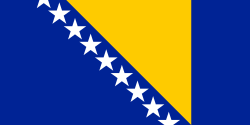
Bosnia and Herzegovina, often referred to as Bosnia-Herzegovina or simply Bosnia, is a country in Southeast Europe situated on the Balkan Peninsula. It borders Serbia to the east, Montenegro to the southeast, and Croatia to the north and southwest, with a 20-kilometre-long coast on the Adriatic Sea. Bosnia has a moderate continental climate with hot summers and cold, snowy winters, and its geography is largely mountainous, particularly in the central and eastern regions dominated by the Dinaric Alps.
🏛️ Early History
The area has been inhabited since at least the Upper Palaeolithic, with permanent human settlement traced to the Neolithic cultures of Butmir, Kakanj, and Vučedol. After the arrival of the first Indo-Europeans, the area was populated by several Illyrian and Celtic civilisations. Most of modern Bosnia was incorporated into the Roman province of Dalmatia by the mid-first century BCE.
🌍 Medieval and Ottoman Period
The ancestors of the modern South Slavic peoples arrived between the sixth and ninth centuries. In the 12th century, the Banate of Bosnia was established as the first independent Bosnian polity, which gradually evolved into the Kingdom of Bosnia. The Ottoman Empire annexed the region in 1463 and introduced Islam.
🏛️ Modern Era
From the late 19th century until World War I, the country was under Austro-Hungarian rule. After World War II, it was granted full republic status in the Socialist Federal Republic of Yugoslavia. In 1992, following the breakup of Yugoslavia, the republic proclaimed independence, which was followed by the Bosnian War ending with the Dayton Agreement in 1995.
👥 Demographics and Government
Bosnia and Herzegovina has around 3.4 million inhabitants, composed chiefly of three main ethnic groups: Bosniaks, Serbs, and Croats. The country has a bicameral legislature and a presidency made up of one member from each of the three major ethnic groups. It consists of two highly autonomous confederal entities—the Federation of Bosnia and Herzegovina and Republika Srpska—and a third unit, the Brčko District.
💰 Economy and International Relations
Bosnia and Herzegovina is a developing country and an upper-middle income economy, dominated by industry and agriculture, followed by tourism and services. It has a social security and universal healthcare system, while primary and secondary education is free. It is a member of the United Nations, Council of Europe, OSCE, and CEFTA, and has been an EU candidate country since 2022.
📜 Name Origins
The first preserved mention of a form of the name “Bosnia” is in De Administrando Imperio from the mid-10th century. The name is believed to derive from the river Bosna, which could derive from the Proto-Indo-European root *bʰegʷ- meaning ‘the running water’. The name Herzegovina means ‘herzog’s [land]’, originating from the title of a 15th-century Bosnian magnate, Stjepan Vukčić Kosača.
🏺 Prehistoric and Roman Era
Bosnia has been inhabited since at least the Paleolithic era, with the Badanj Cave featuring one of the oldest known cave engravings dating back to approximately 13,000 to 12,000 BC. During the Neolithic period, the Butmir culture flourished around 5100 to 4500 BC. Conflict between the Illyrians and Romans started in 229 BCE, but Rome did not complete its annexation of the region until AD 9.
⚔️ Slavic Migration and Medieval Bosnia
Slavs overwhelmed the Balkans in the 6th and 7th centuries, with Early Slavs raiding the Western Balkans including Bosnia. In the High Middle Ages, Bosnia emerged as the Banate of Bosnia under the rule of local bans. The first Bosnian ban known by name was Ban Borić, followed by Ban Kulin, whose rule marked the start of a controversy involving the Bosnian Church.
| Category | Detail | Category | Detail |
|---|---|---|---|
| Capital | Sarajevo | Population | ~3.4 million |
| Major Ethnic Groups | Bosniaks, Serbs, Croats | Government | Bicameral legislature, tripartite presidency |
| Entities | Federation of Bosnia and Herzegovina, Republika Srpska, Brčko District | EU Candidate | Since 2022 |
| Climate | Moderate continental (Bosnia), Mediterranean (Herzegovina) | Independence | 1992 |