
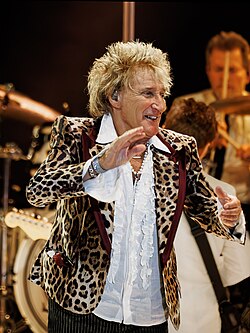
Sir Roderick David Stewart was born on 10 January 1945 in Highgate, North London. He is a British singer and songwriter known for his distinctive raspy singing voice.
🎵 Music Career Beginnings
Stewart’s music career began in 1962 when he took up busking with a harmonica. In 1963, he joined the Dimensions as a harmonica player and vocalist.
In 1964, Stewart joined Long John Baldry and the All Stars before moving to the Jeff Beck Group in 1967. Joining Faces in 1969, he also launched a solo career, releasing his debut album that year.
🏆 Breakthrough and Success
His third album, 1971’s Every Picture Tells a Story, was his breakthrough, topping the charts in the UK, US, Canada and Australia. Its single “Maggie May” also topped charts in those countries.
Stewart had further UK top-ten hits and Faces broke up in 1975. His next few hit singles were ballads, with “Sailing” becoming a hit in the UK and the Netherlands.
🎸 Later Career and Recognition
After a disco and new wave period, Stewart’s music turned to a soft rock/middle-of-the-road style. In 1993, he collaborated with Bryan Adams and Sting on the power ballad “All for Love”.
In 2008, Billboard magazine ranked Stewart the 17th most successful artist on the “Billboard Hot 100 All-Time Top Artists”. He was knighted in Britain’s 2016 Birthday Honours for services to music and charity.
👶 Early Life and Family
Stewart was the youngest of five children of Robert Joseph Stewart and Elsie Rebecca Gilbart. His father was Scottish and his mother was English.
Stewart was born at home during the Second World War. He has called his childhood “fantastically happy”.
⚽ Football and Music
Stewart was the most talented footballer in the family and was a supporter of Arsenal. He became captain of the school football team and played for Middlesex Schoolboys as centre-half.
In summer 1960 he went for trials at Brentford. Stewart stated in his 2012 autobiography that he was never signed to the club and that the club never called him back after his trials.
🎶 Early Musical Influences
The family were great fans of the singer Al Jolson. Stewart’s introduction to rock and roll was hearing Little Richard’s 1956 hit “The Girl Can’t Help It”.
His father bought him a guitar in January 1959. In 1960, he joined a skiffle group with school friends called the Kool Kats.
💼 Early Jobs and Busking
Stewart left school at the age of 15 and worked briefly as a silk-screen printer. He worked in the family shop and as a newspaper delivery boy.
In 1962, Stewart began hanging around folk singer Wizz Jones, busking at Leicester Square and other London spots. On several trips over the next 18 months Jones and Stewart took their act to Brighton and then to Paris.
🎤 Joining the Dimensions and Baldry
After returning to London, Stewart joined a rhythm and blues group, the Dimensions, in October 1963, as a harmonica player and part-time vocalist. It was his first professional job as a musician.
In January 1964, Long John Baldry heard Stewart playing “Smokestack Lightnin’” on his harmonica and offered him a job for £35 a week. Stewart made his recording debut in June 1964 on “Up Above My Head”.
| Year | Event | Group/Album | Notable Fact |
|---|---|---|---|
| 1945 | Born | N/A | Born in Highgate, North London |
| 1962 | Began busking | N/A | Started with harmonica |
| 1963 | Joined Dimensions | Dimensions | First professional musician job |
| 1964 | Joined Baldry | Long John Baldry and the All Stars | Offered £35 a week |
| 1967 | Joined Jeff Beck Group | Jeff Beck Group | Moved from Baldry’s group |
| 1969 | Joined Faces | Faces | Also launched solo career |
| 1971 | Breakthrough album | Every Picture Tells a Story | Topped charts in UK, US, Canada, Australia |
| 1975 | Faces broke up | N/A | Continued solo career |
| 1994 | Inducted into Rock Hall | Solo artist | US Rock and Roll Hall of Fame |
| 2006 | Inducted into UK Music Hall | Solo artist | UK Music Hall of Fame |
| 2012 | Second Rock Hall induction | Faces | As a member of Faces |
| 2016 | Knighted | N/A | For services to music and charity |