
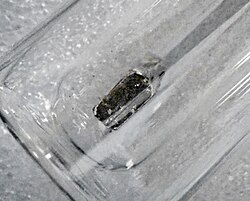
Protactinium is a chemical element with symbol Pa and atomic number 91. It is a dense, radioactive, silvery-gray actinide metal which readily reacts with oxygen, water vapor, and inorganic acids.
🔬 Discovery and Naming
The element was first identified in 1913 by Kazimierz Fajans and Oswald Helmuth Göhring and named “brevium” because of the short half-life of the specific isotope studied. A more stable isotope of protactinium, 231Pa, was discovered in 1917/18 by Lise Meitner in collaboration with Otto Hahn, and they named the element protactinium.
In 1949, the IUPAC chose the name “protactinium” and confirmed Hahn and Meitner as its discoverers. John Arnold Cranston is also credited with discovering the most stable isotope in 1915, but he delayed his announcement due to being called for service in the First World War.
☢️ Isotopes and Radioactivity
The longest-lived and most abundant naturally occurring isotope of protactinium, 231Pa, has a half-life of 32,760 years and occurs in the decay chain of uranium-235. Much smaller trace amounts of the short-lived 234Pa and its nuclear isomer 234mPa occur in the decay chain of uranium-238.
Thirty radioisotopes of protactinium have been discovered, ranging from 210Pa to 239Pa. The most stable are 231Pa with a half-life of 32,650 years, 233Pa with a half-life of 26.975 days, and 230Pa with a half-life of 17.4 days.
🌍 Occurrence and Abundance
Concentrations of protactinium in the Earth’s crust are typically a few parts per trillion, but may reach up to a few parts per million in some uraninite ore deposits. Protactinium occurs in uraninite at concentrations of about 0.3–3 parts 231Pa per million parts of ore.
Protactinium is homogeneously dispersed in most natural materials and in water, but at much lower concentrations on the order of one part per trillion. There is about 500 times more protactinium in sandy soil particles than in water.
⚗️ Chemical Properties
Protactinium forms various chemical compounds, in which it is usually present in the oxidation state +5, but it can also assume +4 and even +3 or +2 states. Protactinium easily reacts with oxygen, water vapor, and acids, but not with alkalis.
At room temperature, protactinium crystallizes in the body-centered tetragonal structure. Protactinium is paramagnetic and no magnetic transitions are known for it at any temperature.
🏭 Production and Uses
Because of its scarcity, high radioactivity, and high toxicity, there are currently no uses for protactinium outside scientific research. For this purpose, protactinium is mostly extracted from spent nuclear fuel.
Two major protactinium isotopes, 231Pa and 233Pa, are produced from thorium in nuclear reactors; both are undesirable and are usually removed. 233Pa is an undesired intermediate product in thorium-based nuclear reactors, and is therefore removed from the active zone of the reactor during the breeding process.
| Property | Value | Property | Value |
|---|---|---|---|
| Symbol | Pa | Atomic Number | 91 |
| Most Stable Isotope | 231Pa | Half-life of 231Pa | 32,760 years |
| Primary Ore Concentration | 0.3–3 ppm | Discovery Year | 1913 |
| Melting Point | Lower than thorium, higher than uranium | Superconductivity | Below 1.4 K |