
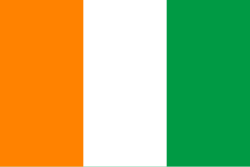
Ivory Coast, also known as Côte d’Ivoire and officially as the Republic of Côte d’Ivoire, is a country on the southern coast of West Africa. Its capital city of Yamoussoukro is located in the centre of the country, while its largest city and economic centre is the port city of Abidjan.
🌍 Geography and Demographics
It borders Guinea to the northwest, Liberia to the west, Mali to the northwest, Burkina Faso to the northeast, Ghana to the east, and the Atlantic Ocean’s Gulf of Guinea to the south. With 31.5 million inhabitants in 2024, Ivory Coast is the third-most populous country in West Africa.
Its official language is French, and indigenous languages are also widely used, including Bété, Baoulé, Dyula, Dan, Anyin, and Cebaara Senufo. In total, there are around 78 languages spoken in Ivory Coast. The country has a religiously diverse population, including numerous followers of Islam, Christianity and traditional faiths often entailing animism.
📜 History and Colonization
Before its colonisation, Ivory Coast was home to several states, including Gyaaman, the Kong Empire, and Baoulé. The area became a protectorate of France in 1843 and was consolidated as a French colony in 1893 amid the Scramble for Africa. It achieved independence in 1960, led by Félix Houphouët-Boigny, who ruled the country until 1993.
Relatively stable by regional standards, Ivory Coast established close political-economic ties with its West African neighbours while maintaining close relations with the West, especially France. Its stability was diminished by a coup d’état in 1999 and two civil wars—first between 2002 and 2007 and again during 2010–2011. It adopted a new constitution in 2016.
💰 Economy and Trade
Through the production of coffee and cocoa, it was an economic powerhouse in West Africa during the 1960s and 1970s, then experienced an economic crisis in the 1980s. Ivory Coast has again experienced high economic growth since the return of peace and political stability in 2011. From 2012 to 2023, the economy grew by an average of 7.1% per year in real terms, the second-fastest rate of economic growth in Africa and fourth-fastest rate in the world.
In 2023, Ivory Coast had the second-highest GDP per capita in West Africa, behind Cape Verde. As of 2023, Ivory Coast is the world’s largest exporter of cocoa beans and has high levels of income for its region. The economy still relies heavily on agriculture, with smallholder cash-crop production predominating.
🏛️ Name and Governance
Originally, Portuguese merchant-explorers in the 15th and 16th centuries divided the west coast of Africa into four “coasts” reflecting resources available from each coast. The coast which they named the Costa do Marfim—meaning ‘coast of ivory’, and translated into French as Côte d’Ivoire—lay between what was known as the Guiné de Cabo Verde and Lower Guinea.
In April 1986, the government declared that Côte d’Ivoire would be its formal name for the purposes of diplomatic protocol and has since officially refused to recognize any translations from French to other languages in its international dealings. Despite the Ivorian government’s request, the English translation “Ivory Coast” is still frequently used in English by various media outlets and publications.
🏛️ Pre-Colonial States
Five important states flourished in Ivory Coast during the pre-European early modern period. The Muslim Kong Empire was established by the Dyula in the early 18th century in the north-central region inhabited by the Sénoufo. The Abron kingdom of Gyaaman was established in the 17th century by an Akan group, the Abron, who had fled the developing Ashanti confederation of Asanteman.
In the mid-17th century in east-central Ivory Coast, other Akan groups fleeing the Asante established a Baoulé kingdom at Sakasso and two Agni kingdoms, Indénié and Sanwi. The Baoulé, like the Ashanti, developed a highly centralised political and administrative structure under three successive rulers.
📊 Key Facts Table
| Category | Fact | Detail | Year/Period |
|---|---|---|---|
| Population | Third-most populous in West Africa | 31.5 million inhabitants | 2024 |
| Official Language | French | 78 languages spoken total | Current |
| Independence | Achieved independence from France | Led by Félix Houphouët-Boigny | 1960 |
| Economic Growth | Second-fastest in Africa | Average 7.1% per year real terms | 2012–2023 |