
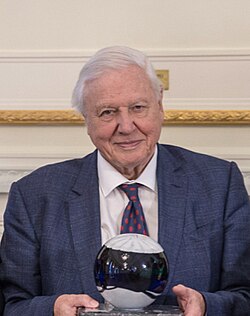
Sir David Frederick Attenborough is an English broadcaster, natural historian, conservationist, writer, producer and narrator. His presenting career began as host of Zoo Quest in 1954 and has spanned eight decades.
🎂 Early Life
David Frederick Attenborough was born on 8 May 1926 in Isleworth, Middlesex. He grew up in College House on the campus of University College, Leicester, where his father, Frederick, was principal.
He is the middle of three sons; his older brother, Richard, became an actor and director, and his younger brother, John, was an executive at the Italian car manufacturer Alfa Romeo. During the Second World War, his parents also fostered two Jewish refugee girls from Germany.
🌿 Childhood Interests
Attenborough spent his childhood collecting fossils, stones and natural specimens. He received encouragement when a young Jacquetta Hawkes admired his collection.
Aged around 11, he heard that the zoology department needed a large supply of newts, which he offered through his father to supply for 3d each. A year later, his adoptive sister Marianne gave him a piece of amber containing prehistoric creatures.
🎓 Education and Military Service
Attenborough was educated at Wyggeston Grammar School for Boys in Leicester. He won a scholarship to Clare College, Cambridge, in 1945 to study geology and zoology and obtained a degree in natural sciences.
In 1947 he was called up for national service in the Royal Navy and spent two years stationed in North Wales and the Firth of Forth.
📺 BBC Career Beginnings
After leaving the navy, Attenborough took a position editing children’s science textbooks for a publishing company. He soon became disillusioned with the work and in 1950 applied for a job as a radio talk producer with the BBC.
He accepted Mary Adams’ offer of a three-month training course. In 1952 he joined the BBC full-time and became a producer for the Talks department.
🦎 Natural History Breakthrough
Attenborough’s association with natural history programmes began when he produced and presented the three-part series Animal Patterns. The studio-bound programme featured animals from London Zoo.
Through this programme, Attenborough met Jack Lester, and they decided to make a series about an animal-collecting expedition. The result was Zoo Quest, first broadcast in 1954, where Attenborough became the presenter at short notice due to Lester being taken ill.
🏛️ BBC Management
Attenborough became Controller of BBC Two in March 1965. He had a clause inserted in his contract that would allow him to continue making programmes on an occasional basis.
In 1969 Attenborough was promoted to director of programmes, making him responsible for the output of both BBC channels. Early in 1973, he left his post to return to full-time programme-making.
🌍 Landmark Series
Beginning with Life on Earth in 1979, Attenborough set about creating a body of work which became a benchmark of quality in wildlife film-making. The series established many of the hallmarks of the BBC’s natural history output.
He is the only person to have won BAFTA Awards in black-and-white, colour, high-definition, 3D and 4K resolution. Over his life, he has collected dozens of honorary degrees and awards.
| Category | Detail | Year | Note |
|---|---|---|---|
| Birth | 8 May 1926 | 1926 | Isleworth, Middlesex |
| Education | Clare College, Cambridge | 1945 | Geology and zoology |
| First Series | Zoo Quest | 1954 | Presenter at short notice |
| BBC Role | Controller of BBC Two | 1965 | Continued making programmes |