
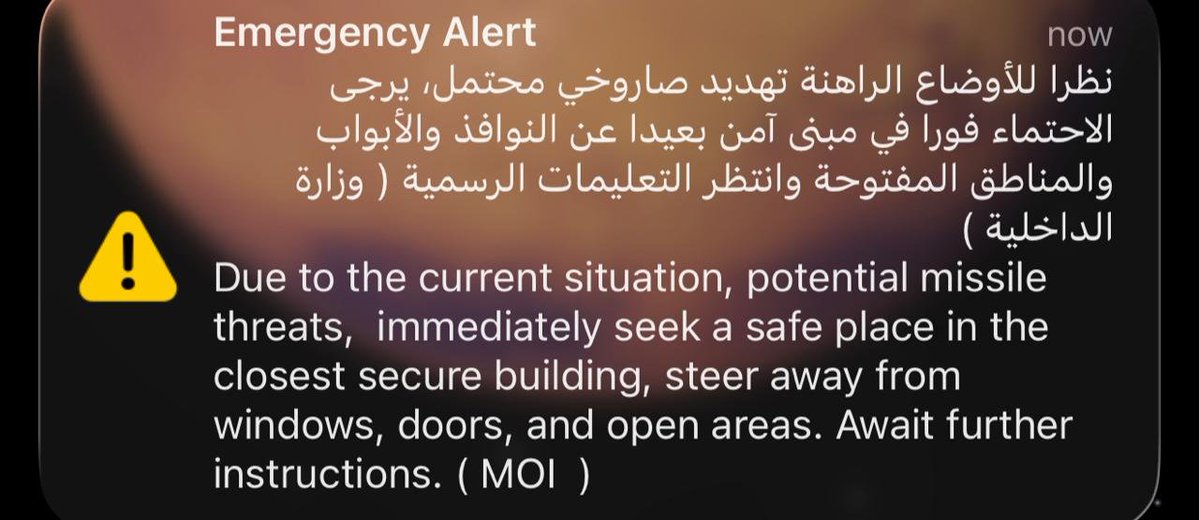
An emergency alert has been sent to mobile phones in the United Arab Emirates. The message, written in both Arabic and English, warns of a potential missile threat. It instructs residents to seek shelter immediately in a secure building, away from windows, doors, and open areas, and to await official instructions.
The alert is signed by the Ministry of Interior (MOI). It was shared online by Mario Nawfal, who posted: “BREAKING! I JUST GOT THIS. I AM IN THE UAE.”
The message is chilling. It is also specific. It is not a test.
Here is what the alert reveals and whether the conflict is restarting.
THE SHORT ANSWER
The alert is real. It was sent to mobile phones in the UAE. It indicates that authorities have detected a credible missile threat. The source is not specified in the message, but the most likely origin is Iran or Iran-backed proxies in the region.
The conflict with Iran has not formally restarted. The ceasefire that began on April 7, 2026, is still technically in place. However, tensions remain extremely high. The US maintains a blockade on Iranian ports. The Strait of Hormuz is under US control. Iran has repeatedly warned of retaliation.
This alert suggests that Iran may have launched or is preparing to launch missiles toward the UAE. Whether this is a single strike or the beginning of a renewed war is unknown. But the situation is dangerously escalated.
WHAT THE MESSAGE REVEALS
The alert reveals several important facts.
The threat is credible. The UAE Ministry of Interior does not send these alerts without cause. The message is not a drill. It is a direct warning to civilians.
The threat is immediate. The language “seek shelter immediately” indicates that the window for safety is short. Missiles may already be in flight.
The threat is regional. The message does not specify a target. It applies broadly to anyone receiving the alert. That likely means the threat is not limited to a single military base or facility. Civilians are at risk.
The source is likely Iran. The UAE has been a target of Iranian missile and drone attacks in the past. In previous conflicts, Iran has struck UAE oil facilities and infrastructure. The current context (US-Iran tensions, the Hormuz blockade) makes Iran the most probable origin.
The alert is coordinated. The message is bilingual. It includes instructions consistent with civil defense protocols. The UAE is activating its emergency response systems.
WHY THE ALERT IS HAPPENING NOW
The timing is not random.
The US-Iran ceasefire is fragile. Active hostilities stopped on April 7, 2026. But no peace treaty has been signed. Iran’s nuclear program has not been dismantled. US naval forces continue to blockade Iranian ports.
Iran has threatened retaliation repeatedly. Iranian officials have stated that the ceasefire is temporary. They have vowed to rebuild their military and strike back when the time is right.
The UAE is a US ally. The UAE hosts US military assets. It is a partner in the blockade. Iran views the UAE as a legitimate target.
The Strait of Hormuz is still contested. The US controls the strait. Iran wants it open. The standoff continues. A missile strike on the UAE would be a dramatic escalation but not out of character.
WILL THE CONFLICT BEGIN AGAIN?
The alert suggests that active hostilities may resume. But one missile strike does not necessarily equal a full war.
Three possible scenarios:
Scenario 1 (Limited strike): Iran launches a small number of missiles at the UAE as a warning. The UAE defense systems intercept most or all of them. Damage is minimal. The US does not retaliate immediately. Tensions spike but war does not restart.
Scenario 2 (Escalation): Iran launches a significant salvo. Some missiles hit targets. Casualties occur. The US and UAE retaliate. The ceasefire collapses. Full-scale war resumes.
Scenario 3 (False alarm or test): The alert is triggered by a false detection, a cyberattack, or a system error. No missiles are actually inbound. The situation de-escalates quickly. This is the least likely scenario.
Most analysts would place the highest probability on Scenario 1 or 2. The alert is real. The threat is credible. The question is scale.
WHAT RESIDENTS SHOULD DO
The Ministry of Interior instructions are clear.
Seek shelter immediately. Go to the closest secure building. Do not stay outside.
Stay away from windows and doors. Glass shatters. Missile fragments can penetrate.
Avoid open areas. Do not stand in parking lots, parks, or streets.
Wait for official instructions. Do not rely on social media. Listen to local news and official channels.
Do not speculate. Spreading unconfirmed information causes panic. Share only what authorities confirm.
Check on vulnerable people. Elderly neighbors, people with disabilities, and children may need assistance.
WHAT THE INTERNATIONAL RESPONSE WILL BE
The United States, Saudi Arabia, and other allies will be monitoring closely.
If Iran is confirmed as the attacker: The US could launch retaliatory strikes against Iranian missile sites. The blockade could be tightened. Diplomatic channels would close.
If the missiles are intercepted with no damage: The response may be limited to diplomatic condemnation and increased military readiness.
If there are casualties: A significant military response is likely. The war could resume within hours.
The next 24 to 48 hours will determine whether this is a isolated incident or the beginning of a wider conflict.
THE BOTTOM LINE
The emergency alert in the UAE is real.
What the message reveals: A credible missile threat is underway. The UAE Ministry of Interior is warning civilians to take shelter. The source is likely Iran.
Will the conflict begin again? Possibly. A single strike could be a warning. A larger attack could restart the war.
What to do: Follow official instructions. Seek shelter. Avoid windows and doors. Await further guidance.
What to expect: The next hours and days will determine whether this is a temporary spike in tensions or the end of the ceasefire.
The situation is fluid. Official information is scarce. Civilians should prioritize safety. The world watches.
What do you think – is this a one-time strike or the beginning of a larger war? Drop your take below. 🇦🇪