
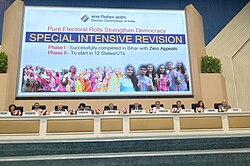
The Special Intensive Revision (SIR) is an exercise undertaken by the Election Commission of India to verify and revise electoral rolls through house to house enumeration, pre-filled forms, and verification of old voter data. The SIR aims to ensure that electoral rolls across India are accurate, by eliminating the names of deceased, permanently shifted, duplicate & non-citizen voters, while ensuring that eligible citizens are not left out.
📜 Legal Basis
Article 324 of Constitution of India and Section 21 (3) of Representation of the People Act, 1950, ECI has the power to revise the electoral rolls across the country in any state without prior permission from any authority. In May 2026, the Supreme Court of India upheld the legitimacy of the Special Intensive Revision (SIR) and held it to be in consonance with the Representation of the People Act, noting that the Election Commission has a Constitutional obligation to conduct free and fair elections.
🗓️ Timeline and Phases
The nationwide SIR process was announced on 27 October 2025 by the Chief Election Commissioner Gyanesh Kumar from Vigyan Bhawan, New Delhi. The first phase was undertaken as an initial rollout in select States, with Bihar being the primary example, conducted between June and September 2025. The second phase started on 27 October 2025, covering nine States and three Union Territories, including Uttar Pradesh and West Bengal. On May 14, 2026, the Election Commission announced SIR Phase-III, covering sixteen states and three Union Territories.
📊 Voter Deletions
In the first phase in Bihar, approximately 47 lakh (4.7 million) electors were removed from the electoral rolls following verification, representing around 5–6% of the total electorate. The second phase resulted in a reduction of approximately 10.2% in the total number of electors, bringing the count down from over 50.99 crore to 45.81 crore. Uttar Pradesh recorded the highest net deletion of 2.04 crore voters, followed by West Bengal with 83.86 lakh.
⚖️ Political Context
Political parties including the Indian National Congress, All India Trinamool Congress, Communist Party of India (Marxist), Samajwadi Party, Dravida Munnetra Kazhagam and Rashtriya Janata Dal opposed the exercise, alleging that the ECI was favouring Prime Minister Narendra Modi and the ruling Bharatiya Janata Party. Senior Congress MP Shashi Tharoor supported the SIR process nationwide, praising both ECI as well as the government for such move. In West Bengal, the most of the controversies took up during the process of SIR immediately after its declaration.
👥 Participation
SIR is a participative exercise involving all stakeholders including electors, political parties and election officials. During SIR Phase-III over 3.94 lakh Booth Level Officers will go house-to-house to 36.73 crore electors assisted by 3.42 lakh Booth Level Agents appointed by political parties. In the first two phases of the SIR in 13 States and UTs covering nearly 59 crore electors, over 6.3 lakh BLOs and 9.2 lakh BLAs appointed by political parties were involved.
| Phase | States/UTs Covered | Key Data | Time Period |
|---|---|---|---|
| Phase I | Select States (e.g., Bihar) | ~47 lakh electors removed in Bihar | June–September 2025 |
| Phase II | 9 States and 3 UTs | ~10.2% reduction; 2.04 crore deleted in UP | October 2025–April 2026 |
| Phase III | 16 States and 3 UTs | 3.94 lakh BLOs, 3.42 lakh BLAs | Announced May 14, 2026 |
| Remaining | Himachal Pradesh, J&K, Ladakh | Schedule to be announced later | Pending |