
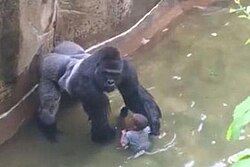
Harambe was a western lowland gorilla who lived at the Cincinnati Zoo. He was born on May 27, 1999, at Gladys Porter Zoo in Brownsville, Texas.
📅 Early Life and Transfer
Harambe was named by Dan Van Coppenolle after the 1988 song “Harambe (Working Together for Freedom)” by Rita Marley. Harambee is a Swahili term for communal labor.
On January 6, 2002, his mother, brother, and half-sister died of chlorine gas poisoning. Harambe was possibly injured in the accident.
On September 18, 2014, Harambe was transferred to the Cincinnati Zoo and Botanical Garden to learn adult gorilla behavior.
⚠️ The Incident on May 28, 2016
A three-year-old boy climbed a 3-foot fence, crawled through bushes, and fell 15 feet into a moat at the Gorilla World habitat. Zoo officials signaled for the three gorillas to return inside, and two females did so.
The 450-pound male silverback Harambe climbed down to investigate the child splashing in the water. Over 10 minutes, Harambe became agitated and disoriented by onlookers’ screams.
Harambe carried the boy through the water and exhibited “strutting” behavior. Afraid for the boy’s welfare, zoo officials killed Harambe with a single rifle shot to the head.
📹 Public Reaction and Investigation
The incident was recorded and uploaded to YouTube, sparking global publicity and controversy. Some observers said it was unclear whether Harambe was likely to harm the child.
Police investigated possible criminal charges against the parents. On June 6, 2016, the mother would not face any charges.
The zoo was investigated by the Association of Zoos and Aquariums and the USDA. Several vigils took place to honor Harambe’s death.
💬 Expert Opinions
Primatologist Jane Goodall said Harambe seemed to be trying to protect the child but concluded the zoo had no choice but to kill him. Zookeeper Jack Hanna defended the zoo’s actions, noting a tranquilizer dart would have taken too long.
Primatologist Frans de Waal said he saw few options for the zoo. Ian Redmond of the Ape Alliance said other options were not tried.
🌐 Internet Memes and Cultural Impact
Harambe became the subject of multiple viral memes, including “Dicks out for Harambe.” Vox wrote that Harambe had “undeniable status as 2016’s meme of the year.”
Cincinnati Zoo director Thane Maynard reacted negatively to the memes. In late August, the zoo deleted its Twitter account after being targeted daily by trolls.
A parody fighting game called Harambe vs. Capcom was released. Rappers Young Thug and Dumbfoundead each released songs entitled “Harambe.”
🗽 Statue and Memorials
On October 18, 2021, a 7-foot-tall bronze statue of Harambe was placed in Bowling Green Park in New York City. The statue faced the Charging Bull and was surrounded by 10,000 bananas as a statement about wealth disparity.
In October 2023, a pedestrian bridge in Mauldin, South Carolina, was listed as “Harambe Memorial Bridge” on Google Maps. In February 2024, it was officially named the Mauldin Gateway Bridge.
📅 Later Developments
In September 2017, the zoo added Mshindi, a 29-year-old male western lowland gorilla. The zoo created a new indoor habitat where the public can view gorillas year-round from behind safety glass.
On the 2023 World Gorilla Day, the feature-length documentary Harambe was released. The film is critical of Harambe’s killing and claims new evidence that Harambe was trying to return the boy to his parents.
| Date | Event | Location | Key Detail |
|---|---|---|---|
| May 27, 1999 | Harambe born | Gladys Porter Zoo, Texas | Named after Swahili term for communal labor |
| January 6, 2002 | Family died | Gladys Porter Zoo | Chlorine gas poisoning; Harambe possibly injured |
| September 18, 2014 | Transferred to Cincinnati Zoo | Cincinnati Zoo | To learn adult gorilla behavior |
| May 28, 2016 | Incident and death | Cincinnati Zoo | Boy fell into moat; Harambe shot and killed |