
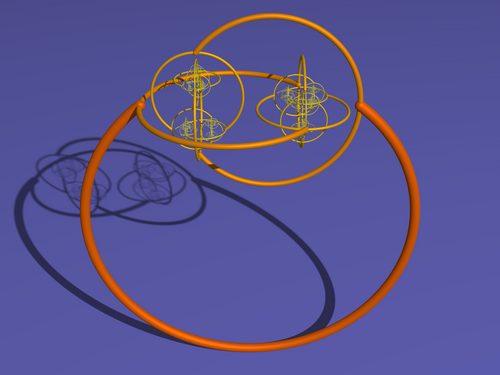
The Alexander horned sphere is a pathological embedding of the 2-sphere into 3-dimensional Euclidean space. The topological object was discovered by J. W. Alexander (1924).
🔍 Discovery and Context
In the late 19th century, the Jordan curve theorem established that every simple closed curve in the plane divides it into two regions. Mathematicians sought to generalize this to higher dimensions. The Schoenflies theorem successfully proved that in two dimensions, any such curve is “well-behaved.”
In 1921, Louis Antoine constructed Antoine’s necklace, a Cantor set in R^3 whose complement is not simply connected. In 1924, James Waddell Alexander II published his findings on the horned sphere as a definitive counterexample.
⚙️ Construction Process
The construction of the Alexander horned sphere is an iterative process starting with a standard torus. The Alexander horned sphere is the limit of this process as the number of iterations approaches infinity.
By considering only the points of the tori that are not removed at some stage, the result is an embedding of the sphere with a Cantor set removed. The resulting boundary is a continuous surface.
🌐 Topological Properties
The interior of the Alexander horned sphere is homeomorphic to the open unit 3-ball. Any loop drawn entirely within the interior can be continuously contracted to a point without leaving the interior.
The exterior region is where the “pathology” resides. The fundamental group of the exterior is non-trivial, meaning there exist loops that cannot be continuously shrunk to a point without passing through the surface.
🔬 Key Characteristics
Despite its appearance, the Alexander horned sphere is homeomorphic to the standard unit sphere. From an intrinsic point of view, the horned sphere has no holes, no edges, and is perfectly “normal.”
The Alexander horned sphere is locally flat everywhere except at the points of its limit set. At these Cantor points, the sphere is “wild.”
| Property | Standard Sphere | Alexander Horned Sphere |
|---|---|---|
| Interior simply connected | Yes | Yes |
| Exterior simply connected | Yes | No |
| Homeomorphic to S^2 | Yes | Yes |
| Locally flat everywhere | Yes | No |