
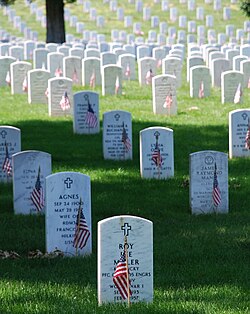
Memorial Day is a federal holiday in the United States for mourning the U.S. military personnel who died while serving in the U.S. Armed Forces. It is observed on the last Monday of May.
Memorial Day is a time for visiting cemeteries and memorials to mourn the military personnel who died in the line of duty. Volunteers will place American flags on the graves of those military personnel in national cemeteries.
📜 Origins and First Observance
The first national observance of what would become Memorial Day occurred on May 30, 1868. Then known as Decoration Day, the holiday was proclaimed by Commander-in-Chief John A. Logan of the Grand Army of the Republic to honor Union soldiers who had died in the American Civil War.
The National Cemetery Administration credits Mary Ann Williams of the Ladies Memorial Association of Columbus, Georgia, with originating the idea of an annual date to decorate the graves of Civil War veterans with flowers. Official recognition as a holiday spread among the states, beginning with New York in 1873.
🏛️ Official Recognition and Name Change
By 1890, every state had adopted the holiday. The world wars turned it into a day of remembrance for all members of the U.S. military who fought and died in service.
In 1968, Congress changed its observance to the last Monday in May, and in 1971 standardized its name as “Memorial Day.” Two other days celebrate those who have served or are serving in the U.S. military: Armed Forces Day and Veterans Day.
🏙️ Claims of Origination
A variety of cities and people have claimed origination of Memorial Day. In some cases, the claims relate to documented events occurring before or after the Civil War.
On May 1, 1865, in Charleston, South Carolina, the recently freed Black population held a parade of 10,000 people to honor 257 dead Union soldiers. Historian David Blight has called this commemoration the first Memorial Day, though no direct link has been established between this event and General John Logan’s 1868 proclamation.
🌸 Southern Traditions and Ladies’ Memorial Association
The National Cemetery Administration and scholars attribute the beginning of a Memorial Day practice in the South to the Ladies Memorial Association of Columbus, Georgia. Mary Ann Williams wrote an open letter on March 11, 1866, asking for assistance in establishing an annual holiday to decorate the graves of soldiers throughout the South.
The holiday was observed in Atlanta, Augusta, Macon, Columbus and elsewhere in Georgia as well as Montgomery, Alabama; Memphis, Tennessee; and across the South. After General Logan’s General Order No. 11 to observe May 30, 1868, the earlier version of the holiday began to be referred to as Confederate Memorial Day.
🏅 Presidential Proclamation and Waterloo, New York
On May 26, 1966, President Lyndon B. Johnson designated an “official” birthplace of the holiday by signing the presidential proclamation naming Waterloo, New York, as the holder of the title. This action followed House Concurrent Resolution 587, in which the 89th Congress had officially recognized that the patriotic tradition of observing Memorial Day had begun one hundred years prior in Waterloo, New York.
The legitimacy of this claim has been called into question by several scholars.
| Date | Event | Location | Significance |
|---|---|---|---|
| June 3, 1861 | First Civil War soldier’s grave decorated | Warrenton, Virginia | Funeral of John Quincy Marr, first soldier killed in the Civil War |
| April 26, 1865 | Sue Landon Vaughan decorated graves | Jackson, Mississippi | Decorated graves of Confederate and Union soldiers |
| May 1, 1865 | Parade of 10,000 freed Black people | Charleston, South Carolina | Honored 257 dead Union soldiers; called first Memorial Day by historian David Blight |
| May 30, 1868 | First national observance of Decoration Day | Nationwide (proclaimed by John A. Logan) | Proclaimed by Commander-in-Chief John A. Logan of the Grand Army of the Republic |