
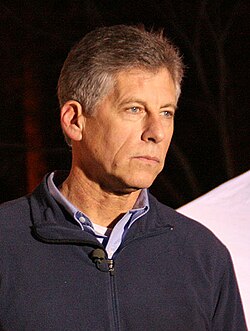
Mark Fuhrman (February 5, 1952 – May 12, 2026) was an American law enforcement officer, author, and commentator. As a detective for the Los Angeles Police Department (LAPD), he became known for his role in the Nicole Brown Simpson and Ron Goldman murder investigation and the subsequent prosecution of O. J. Simpson.
📜 Early Life and Military Service
Fuhrman was born in Eatonville, Washington, on February 5, 1952. He attended Peninsula High School in Gig Harbor, Washington. Fuhrman’s parents divorced when he was seven years old, and his mother remarried briefly.
In 1970, at the age of 18, he enlisted in the United States Marine Corps, where he was trained as a machine gunner and military policeman. He served during the Vietnam War era, although his service in the Vietnam theater was restricted to being assigned to the USS New Orleans, an amphibious assault ship stationed offshore. Having attained the rank of sergeant, he was honorably discharged in 1975.
👮 LAPD Career and Psychiatric Interviews
After leaving the military, Fuhrman entered the Los Angeles Police Academy and graduated in 1975. In 1981, Fuhrman requested leave for workers’ compensation. During a psychiatric interview regarding this claim, Fuhrman expressed racist sentiments, stating that he stopped enjoying military service because of alleged insubordination from Mexican-Americans and African-Americans, whom he described as “niggers”.
Fuhrman received workers’ compensation and remained on paid leave until 1983. During this time, Fuhrman attempted to leave the police force permanently and receive a stress disability pension. In a 1982 psychiatric interview, he claimed that he had “tortur[ed] suspects and con[ned] internal affairs detectives”, that he would choke suspects and break their arms and legs “if necessary”, and that he had pounded suspects’ faces to “mush”.
Fuhrman claimed that he was afraid he would kill someone if he were returned to street patrol. Although several psychiatrists recommended that he be removed from duty completely, and others recommended that he not be allowed to carry a gun, the City of Los Angeles argued that Fuhrman’s statements were merely part of an elaborate ruse to win a pension. In 1983, Fuhrman lost his case, and a subsequent appeal to Superior Court was rejected; therefore, Fuhrman returned to active duty as a police officer.
🔪 The Simpson Case Investigation
In 1985, Fuhrman responded to a domestic violence call between retired NFL football player O. J. Simpson and his wife, Nicole Brown Simpson. In 1989, a statement by Fuhrman about this call resulted in Simpson’s arrest for spousal abuse. Fuhrman was promoted to detective in 1989.
Brown and Ron Goldman were murdered outside Brown’s Brentwood, Los Angeles, condominium on the night of June 12, 1994. At least 14 officers and supervisors, some of whom arrived on the scene before Fuhrman, reported seeing only one glove. Fuhrman and his superior, Ronald Phillips, were the first detectives to arrive.
At the Simpson residence, Fuhrman found a number of blood drops in and on a white Ford Bronco parked outside. Fuhrman then climbed over the wall of the property in order to let in the other detectives. They later testified that they entered Simpson’s estate without a search warrant due to exigent circumstances – specifically, a concern that Simpson himself might have been harmed.
An investigation of the property by Fuhrman produced a second bloody glove, which was later determined to be the right-hand mate of the glove found at the murder scene. The glove found on the Simpson estate, which – according to DNA testing – was soaked with the blood of both victims, was considered to be one of the strongest pieces of evidence for the prosecution.
⚖️ Trial Testimony and Perjury
In 1995, Fuhrman was called to testify regarding his discovery of evidence in the Simpson case, including a bloody glove recovered at Simpson’s estate. During the trial, witnesses claimed that in the 1980s, Fuhrman frequently described African Americans with a racist epithet, claims he denied. In response, Simpson’s defense team produced recorded interviews with Fuhrman and witnesses proved that he had repeatedly used racist language during those interviews.
As a result, the defense claimed that Fuhrman had committed perjury and was not a credible witness. The credibility of the prosecution has been cited as one reason Simpson was acquitted. The defense claimed that Fuhrman planted key evidence as part of a racially motivated plot against Simpson.
When asked under oath (with the jury not present), Fuhrman declined to answer all questions, invoking his Fifth Amendment right. These questions included whether he planted or manufactured evidence. Fuhrman retired from the LAPD in 1995. In 1996, he pleaded no contest to perjury for his false testimony related to his use of racial epithets.
🎙️ Recorded Interviews and Witness Testimony
Between 1985 and 1994, Fuhrman gave taped interviews to Laura Hart McKinny, a writer working on a screenplay about female police officers. The recordings contain 41 instances of the word “nigger” used as recently as 1988, including references in which Fuhrman claims to have perpetrated violence against African-Americans.
Witness Kathleen Bell testified that she had met Fuhrman at a Marine recruiting station in 1985 or 1986, where she claimed that he expressed animus against interracial couples and said, “If I had my way, all the niggers would be gathered together and burned.” Witness Natalie Singer testified that Fuhrman had told her, “The only good nigger is a dead nigger.” Roderic Hodge then testified that while he was in police custody in 1987, Fuhrman had said to him, “I told you we would get you, nigger.”
📊 Key Facts Table
| Category | Detail | Year | Outcome |
|---|---|---|---|
| Birth | Born in Eatonville, Washington | 1952 | N/A |
| Military Service | US Marine Corps, machine gunner and MP | 1970-1975 | Honorable discharge |
| LAPD Career | Joined LAPD after academy graduation | 1975 | Retired in 1995 |
| Psychiatric Interviews | Expressed racist sentiments and claimed violence | 1981-1982 | Lost pension case, returned to duty |
| Simpson Domestic Violence Call | Responded to call between Simpson and Brown | 1985 | Led to 1989 arrest for spousal abuse |
| Murder Investigation | Discovered bloody glove at Simpson’s estate | 1994 | Key prosecution evidence |
| Trial Testimony | Denied using racial epithets in last 10 years | 1995 | Proved false by recordings |
| Perjury Charge | Pleaded no contest to perjury | 1996 | Conviction for false testimony |