
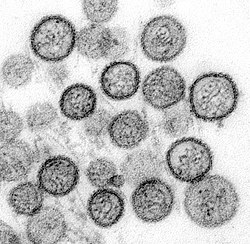
Orthohantavirus is a genus of viruses that includes all hantaviruses (family Hantaviridae) that cause disease in humans. Orthohantaviruses, hereinafter referred to as hantaviruses, are naturally found primarily in rodents.
🦠 Transmission and Diseases
Hantaviruses are transmitted mainly through aerosols and droplets that contain rodent excretions, as well as through contaminated food, bites, and scratches. Environmental factors such as rainfall, temperature, and humidity influence transmission.
In humans, hantaviruses cause two diseases: hemorrhagic fever with renal syndrome (HFRS) and hantavirus pulmonary syndrome (HPS). HFRS is mainly caused by hantaviruses in Africa, Asia, and Europe, called Old World hantaviruses, and HPS is usually caused by hantaviruses in the Americas, called New World hantaviruses.
🧬 Virus Structure and Replication
The hantavirus genome consists of three single-stranded negative-sense RNA segments that encode one protein each: an RNA-dependent RNA polymerase (RdRp), a spike glycoprotein precursor, and the N protein. Segments are encased in N proteins to form ribonucleoprotein (RNP) complexes that each have a copy of RdRp attached.
Replication begins when spikes attach to the surface of cells. Old World hantaviruses assemble in the Golgi apparatus and obtain their envelope from it, while New World hantaviruses assemble near the cell membrane and obtain their envelope from it as they leave the cell by budding from its surface.
📜 History and Discovery
Hantaviruses were first discovered following the Korean War. During the war, HFRS was a common ailment in soldiers stationed near the Hantan river. The first hantavirus was isolated in 1978 in South Korea, and was named the Hantaan virus.
In 1993, an outbreak of HPS occurred in the Four Corners region in the United States, which led to the discovery of pathogenic New World hantaviruses and the second disease caused by hantaviruses. Since then, hantaviruses have been found not just in rodents but also in moles, shrews, and bats.
📊 Disease Characteristics and Risk Factors
HFRS is characterized by five phases: febrile, hypotensive, low urine production (oliguria), high urine production (polyuria), and recovery. The case fatality rate of HFRS varies from less than 1% to 15% depending on the virus.
HPS has a higher case fatality rate than HFRS, at 30–60%. HPS is mainly caused by two viruses: Andes virus and Sin Nombre virus.
Living in a rural environment, in unhygienic settings, and interacting with environments shared with hosts are the biggest risk factors for infection. Deforestation and excess agriculture may destroy rodents’ natural habitat.
| Category | Old World Hantaviruses | New World Hantaviruses | General Facts |
|---|---|---|---|
| Primary Disease | Hemorrhagic fever with renal syndrome (HFRS) | Hantavirus pulmonary syndrome (HPS) | Both diseases involve increased vascular permeability |
| Geographic Location | Africa, Asia, and Europe | The Americas | Found worldwide in rodents |
| Case Fatality Rate | Less than 1% to 15% | 30–60% | Recovering from infection likely grants life-long immunity |
| Primary Transmission | Aerosols and droplets from rodent excretions | Aerosols and droplets from rodent excretions | Andes virus has documented limited human-to-human transmission |